
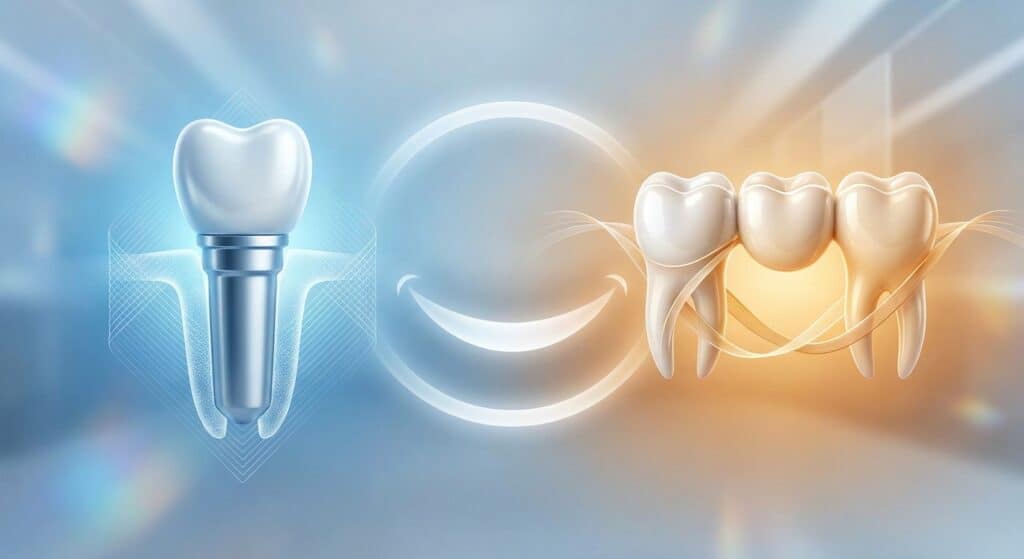
Dental implant with a crown, showing the connection between the implant and natural teeth.

Dental Implants vs Bridges: Your Smile Restoration Options

Considering dental implants bridge options for tooth replacement? Compare implants vs. bridges to discover the best solution for your smile's function and appearance. Learn more.

Understanding Missing Teeth and Restoration Options

When facing missing teeth, exploring options like dental implants and bridges is essential for restoring your smile’s appearance and function. Both methods offer pathways to a confident, natural-looking smile but utilize different approaches. Understanding these fundamental differences is the first step toward making an informed decision about your oral health.

Missing teeth can lead to adjacent teeth shifting, jawbone deterioration, and difficulties with chewing and speaking. Fortunately, modern dentistry provides effective solutions, with implants and bridges being the most common restorations. Each offers unique benefits and considerations, making professional consultation vital to determine the best fit for your individual needs. For more information on general dental care and preventative measures, you can explore our family dental tips.

Restoration TypeDental ImplantsDental Bridges
StructureA titanium post surgically placed into the jawbone, acting as an artificial tooth root, topped with a crown.One or more artificial teeth (pontics) anchored to natural teeth or implants on either side.
InvasivenessSurgical procedure required for implant placement.Generally less invasive, often involving preparation of adjacent teeth.
Bone PreservationStimulates jawbone, preventing bone loss.Does not prevent bone loss beneath the missing tooth’s site.
Impact on Adjacent TeethDoes not affect healthy adjacent teeth.Requires altering or crowning adjacent healthy teeth to support the bridge.
LongevityCan last a lifetime with proper care.Typically lasts 10-15 years, sometimes longer with excellent care.
MaintenanceRequires regular brushing and flossing, similar to natural teeth.Requires meticulous cleaning under and around the pontic and abutment teeth.
Procedure TimeCan take several months due to healing time.Often completed in two dental visits over a few weeks.

What Are Dental Implants?

Dental implants are a highly effective and long-lasting solution for tooth replacement. They are surgically placed into the jawbone and act as artificial tooth roots, providing a stable foundation for a replacement tooth. For more information on dental restorations, check out our dental restoration life guide.

Dental implants are a sophisticated and permanent solution for replacing missing teeth, offering a stable foundation that closely mimics the natural root structure of your own teeth. They are surgically placed into the jawbone, providing a secure base for crowns, bridges, or dentures. This integration with the bone, known as osseointegration, ensures exceptional stability and longevity for your restored smile.

The process begins with a thorough consultation and examination by your dental professional to assess your suitability and plan the implant placement. This initial stage is crucial for achieving a secure, natural-looking smile with superior function. The implant post is then surgically placed into the jawbone, requiring time to fuse with the bone through osseointegration.

Following successful integration, a connector piece called an abutment is attached to the implant post. Finally, a custom-made crown, bridge, or denture is attached to the abutment, completing the transformation and restoring your smile’s appearance and function. This multi-step process results in a durable and effective solution for tooth loss.

What Are Dental Bridges?

A dental bridge is a dental restoration used to replace one or more missing teeth by bridging the gap between them. This common restorative option relies on the natural teeth or dental implants adjacent to the gap for support. By anchoring to these adjacent structures, a dental bridge effectively restores the function and appearance of your smile, allowing you to eat and speak with confidence.

The primary function of a dental bridge is to restore the continuity of your smile, preventing the remaining teeth from shifting into the empty space. This shifting can lead to further dental problems, including bite issues and increased risk of gum disease. Bridges are custom-made to match your natural teeth, ensuring a seamless and aesthetically pleasing result that enhances your overall oral health.

There are several types of dental bridges, including traditional bridges, cantilever bridges, and Maryland bridges. Traditional bridges involve crowns on adjacent teeth or implants with a pontic in between. Cantilever bridges are used when teeth are only on one side of the gap, and Maryland bridges are bonded to the back of adjacent teeth, requiring less alteration.

Dental Implants vs. Dental Bridges: Key Differences

Dental implants and bridges offer distinct approaches to replacing missing teeth. Implants act as artificial roots, surgically placed in the jawbone, providing a stable base for a new tooth without affecting adjacent teeth. Bridges, conversely, use neighboring teeth as anchors, supporting a prosthetic tooth to span the gap.

Implants stimulate the jawbone, preventing bone loss, while bridges do not offer this benefit, potentially leading to jawbone deterioration over time. The procedure for implants involves surgery and healing, making it a longer process than bridges, which can often be completed in a few visits.

While bridges typically last 5-15 years and require careful maintenance of supporting teeth, implants are designed as a permanent solution with proper care. The choice depends on individual oral health, budget, and long-term goals.

Pros and Cons of Dental Implants

Dental implants offer a highly effective and long-lasting solution for replacing missing teeth, providing numerous benefits for both oral health and overall confidence. They are designed to mimic the natural structure and function of your own teeth, integrating directly with your jawbone for unparalleled stability. For more information on maintaining your smile, explore our family dental tips.

The advantages of dental implants are significant, including their ability to preserve jawbone density, which is crucial for maintaining facial structure and preventing the sunken appearance that can occur with tooth loss. Unlike traditional bridges, implants do not require altering adjacent healthy teeth, making them a more conservative choice. For many, they offer a natural feel and appearance, allowing for confident eating, speaking, and smiling. The longevity of dental implants is another major plus, often lasting a lifetime with proper care.

However, there are potential drawbacks to consider when opting for dental implants. The initial cost of dental implants can be higher compared to other restorative options, although their long-term durability often makes them more cost-effective over time. The treatment process itself can also be lengthy, sometimes taking several months from initial placement to the final restoration, depending on individual healing and bone integration. Dental implant success is also dependent on good oral hygiene and overall health, so thorough consultation and preparation are essential.

Pros and Cons of Dental Bridges

Dental bridges offer a common solution for replacing missing teeth, restoring function and aesthetics. They are often chosen for their relatively quicker treatment time and lower initial cost compared to implants.

However, bridges require altering adjacent healthy teeth to serve as anchors, which can increase their risk of decay or damage over time. Unlike implants, traditional bridges do not stimulate the jawbone beneath the missing tooth, potentially leading to gradual bone loss.

While bridges can provide a secure and natural-looking smile, they involve trade-offs. Understanding these advantages, such as shorter treatment and lower upfront cost, and disadvantages, like the impact on adjacent teeth and potential bone loss, is crucial for making an informed decision about your oral health. For more general advice, consider these family dental tips.

Who Is a Good Candidate for Dental Implants?

Suitability for dental implants is determined through a dental professional’s evaluation. Essential criteria include adequate jawbone density for support, good oral hygiene, and overall good health. These elements are vital for the implant to integrate successfully with the bone, a process called osseointegration.

Ideal candidates generally have no active gum disease and a robust immune system. Certain conditions, such as uncontrolled diabetes or recent radiation therapy to the head/neck, might affect eligibility due to potential healing complications. A detailed dental and medical history review, along with imaging like X-rays or CT scans, aids in assessing candidacy. Heritage Dental Centre can assist in this evaluation to explore your smile restoration options.

Key considerations include sufficient jawbone density for secure anchoring, which may require bone grafting if loss has occurred. Excellent oral hygiene is critical for long-term success, preventing infections like peri-implantitis through regular care. Discussing your medical history and medications with your dentist is also vital, as chronic conditions and lifestyle choices can impact healing. Non-smoker status is preferred, as smoking can increase the risk of implant failure.

Who Is a Good Candidate for Dental Bridges?

Dental bridges are an effective solution for individuals seeking to restore their smile after tooth loss. Ideal candidates typically have healthy gums and adjacent teeth strong enough to support the bridge. These supporting teeth, known as abutment teeth, are crucial for the restoration’s stability and longevity.

The extent of tooth loss is also a key factor; bridges are generally suitable for replacing one or a few missing teeth in a row. Patients should also possess good oral hygiene habits to maintain the health of their natural teeth and gums, which are essential for supporting the bridge. A thorough dental examination will determine your suitability.

Key requirements include healthy gums and adjacent teeth free from significant decay or periodontal disease, as these teeth will anchor the bridge. Consistent brushing and flossing are vital for long-term success, preventing decay and gum disease around the abutment teeth. While bridges don’t integrate with the jawbone like implants, adequate bone structure is necessary to support the gums and provide a stable foundation. Bridges offer a fixed solution, permanently cemented for a stable and natural feel during eating and speaking.

The Procedure: What to Expect

Restoring your smile with dental implants or bridges involves distinct procedures. Understanding these steps helps manage expectations regarding timelines and the overall process. Both options replace missing teeth, but the surgical and restorative phases differ significantly. For more information on maintaining oral health, check out our family dental tips.

The dental implant procedure typically occurs in multiple stages over several months. It begins with surgically placing a titanium post into the jawbone, which then fuses with the bone through osseointegration. Once stable, an abutment is attached, followed by a custom-made crown, creating a new, natural-looking tooth. Learn more about the benefits of dental implants for permanent tooth replacement.

In contrast, dental bridges offer a quicker restoration process, usually requiring fewer visits. This involves preparing adjacent teeth (abutment teeth) by reshaping them to accommodate crowns. These crowns are then cemented onto the prepared teeth, with a false tooth suspended between them to fill the gap. Exploring the effectiveness of dental bridges for smile restoration is a valuable step.

Cost Considerations for Implants and Bridges

Understanding the financial investment for dental implants and bridges is a crucial part of the decision-making process. While both options restore missing teeth, their costs can vary significantly due to the materials used, the complexity of the procedure, and the specific needs of the patient. Our team at Heritage Dental Centre is committed to providing transparent pricing and exploring all available payment options to make your smile restoration journey accessible. For general dental care advice, consider these family dental tips.

Several factors contribute to the overall cost of dental implants. These include the number of implants needed, the type of abutment and crown used, and whether any preliminary procedures like bone grafting are necessary. Dental implants are often a more significant upfront investment, but their longevity and ability to preserve jawbone health can offer long-term value. Information on dental implant costs in Edmonton can provide a clearer picture of potential expenses.

Similarly, the cost of dental bridges is influenced by various elements. This includes the number of artificial teeth (pontics) required to fill the gap, the materials used for the bridge and supporting crowns, and the complexity of preparing the adjacent teeth. Dental bridges can sometimes be a more immediate and potentially less expensive solution compared to implants, though they may require replacement over time. For detailed information, you can review dental bridge costs.

When comparing the financial aspects, it’s important to consider the long-term value. While dental implants represent a higher initial cost, their durability and bone-preserving qualities can make them more cost-effective over a lifetime, as they often do not require replacement. Dental bridges, while less expensive initially, may need periodic adjustments or eventual replacement, contributing to costs over time. Understanding these differences helps in making an informed financial decision for your oral health. For a general overview of how bridges and implants compare financially and functionally, exploring resources that discuss bridges vs. implants can be beneficial.

Maintaining Your Restored Smile

Proper care is essential for the longevity of dental implants and bridges. Regular brushing and flossing, just like with natural teeth, prevent plaque and tartar buildup. Consistent at-home care combined with professional dental check-ups ensures your restored smile remains healthy and functional. For more on this, check out our advanced tips for a healthier smile.

For implants, gently brush around the abutment and use interdental brushes or floss to clean beneath the crown. Avoid abrasive toothpaste and harsh brushing to protect implant components and gum tissue. For bridges, cleaning beneath the pontic (the artificial tooth) is crucial; specialized floss threaders or interdental brushes are ideal for this task.

Meticulous cleaning around implant crowns and gum lines prevents peri-implantitis. For bridges, ensure thorough cleaning under the pontic and around supporting crowns to remove food particles and prevent decay or gum disease. Regular dental visits are vital for professional cleanings and examinations, aiding in the early detection of any issues with your restorations. Please contact us to schedule an appointment.

Making the Right Choice for Your Smile

Choosing between dental implants and dental bridges involves careful consideration of your unique dental situation, financial circumstances, and long-term health objectives. While both options can effectively restore your smile and oral function, they differ significantly in their procedure, durability, and impact on surrounding teeth. A personalized consultation with your dental professional is the most crucial step in determining the most suitable restoration for your specific needs.

To help you weigh the options, consider these factors. Dental implants offer a permanent solution by integrating directly with the jawbone, which helps preserve bone density and provides a stable foundation for a replacement tooth. This makes them a highly effective choice for many seeking a secure, natural-looking smile. On the other hand, dental bridges are designed to fill the gap left by missing teeth by anchoring to adjacent natural teeth or implants. They can restore your smile’s appearance and improve chewing ability, offering a reliable method for smile restoration.

Understanding the long-term benefits and potential challenges of each is vital. Dental implants, while often requiring a higher initial investment, can offer a lifetime of reliable function with proper care, making them an excellent investment in your oral health. Dental bridges may present a more immediate and often less expensive solution, but they can sometimes affect the health of the supporting teeth over time and do not prevent bone loss in the gap area. Exploring all possibilities, including options like implant-supported bridges, can lead to the most confident and lasting outcome for your smile.

Your Path to a Confident Smile

Choosing between dental implants and bridges is a significant step toward restoring your smile’s function and appearance. While both options effectively address missing teeth, they offer different benefits and procedures. Understanding these distinctions is crucial for making an informed decision that aligns with your oral health goals and lifestyle. Our team at Heritage Dental Centre is dedicated to guiding you through this process, ensuring you feel confident about your choice.

We encourage you to schedule a personalized consultation to discuss your specific needs. During this appointment, our dental professionals can conduct a thorough examination, answer all your questions about dental implant and bridge options, and recommend the most suitable treatment plan for you. Taking this proactive step is the key to achieving a lasting, beautiful smile that you can be proud of.

Don’t let missing teeth hold you back any longer. Explore the possibilities for a revitalized smile by contacting us today to book your appointment. We are committed to providing you with exceptional care and helping you regain the confidence that comes with a complete and healthy set of teeth. Visit our contact page to learn more about scheduling your visit and beginning your journey to a renewed smile.

Sign Up for an Appointment

It just takes a few minutes to book a visit online.

"*" indicates required fields

Name*
MM slash DD slash YYYY
Dental Blog

More Dental Blog Posts

Keep reading some of our latest articles about all things dental.